
The Real ROI of Commercial LED Displays: What the Data Shows
Updated: Aug 18

"Is this actually worth it?" is the question every business asks before signing off on an LED display project — and it's a fair one, given the capital involved. The honest answer requires looking past the upfront quote.
Start with total cost of ownership, not purchase price
The purchase price of an LED display is only one line in a much longer-running cost model. The other variables — expected lifespan, energy consumption, maintenance, and how long the technology stays current — matter just as much over a 5-to-10-year horizon. Current-generation LED panels are commonly rated for 100,000+ operating hours, which at typical business-hours usage translates to well over a decade of service life before major component replacement is needed.
What the market growth itself signals
Independent market research consistently shows the commercial LED display market growing at a compound annual rate above 10% through the early 2030s, with adoption climbing fastest in retail, corporate, hospitality, and public-sector deployments. Markets don't sustain double-digit growth for years on hardware that doesn't pay for itself — that trajectory is itself a signal that businesses adopting the technology are seeing return on it.
Engagement and action, not just impressions
For businesses focused on customer-facing use cases — retail storefronts, restaurant menu boards, event spaces — the more relevant ROI question isn't "how many people saw it" but "what did people do after seeing it." Research on digital out-of-home advertising has found that a strong majority of consumers take some measurable action — a search, a store visit, a purchase — after exposure. That's a meaningfully different outcome than the brand-awareness-only case static signage has traditionally been sold on.
Where ROI actually gets lost
In our experience, the projects that underperform almost never fail because of the display technology itself. They fail because of decisions made around it:
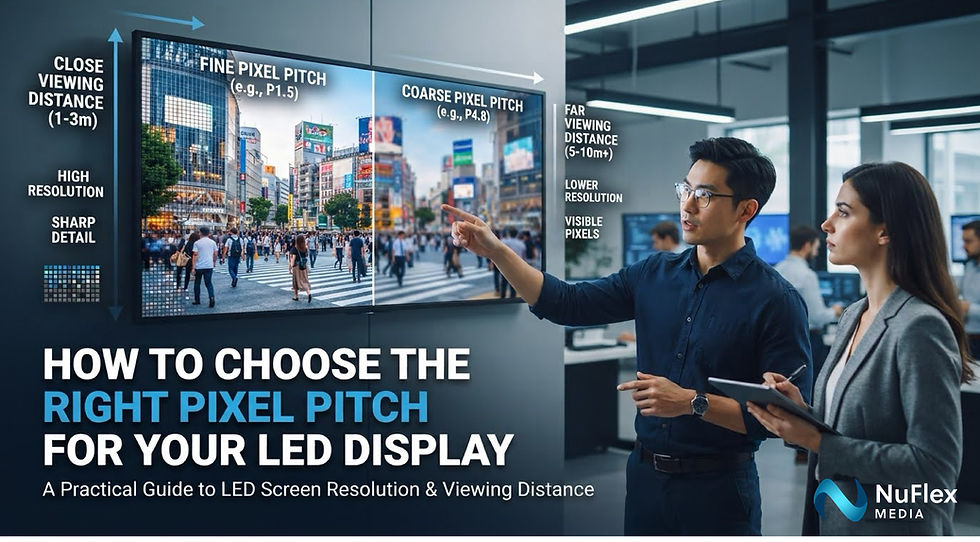
Wrong pixel pitch for the space, making content look soft or unnecessarily expensive
No content strategy, so an expensive display just loops a static logo
Lowest-bid vendor selection, leading to panel failures and no real support when something breaks
Skipping the design consultation, resulting in a display that doesn't match the room's lighting or viewing distance
A simple framework for estimating your own payback
Divide the total installed cost by the expected useful life in years to get an annualized cost. Then estimate the annual value of the outcome you care about — incremental foot traffic, reduced print/signage costs, faster boardroom decision-making, or brand impression value for a high-visibility location. If the annualized cost is meaningfully below that estimated value, the investment case is strong. This is a simplified model, but it's a far better starting point than comparing quotes on price alone.
The bottom line
LED displays are a real capital investment, and treating them as an impulse purchase is how ROI disappears. Treated as infrastructure — planned around lifespan, content, and the specific business outcome it needs to drive — the data consistently supports the investment.
NuFlex Media builds the ROI conversation into every design consultation, before any hardware is specified. Talk to us about what the numbers would look like for your project.


Comments