
Outdoor LED Displays vs. Traditional Billboards: A Cost & Impact Comparison
Updated: Aug 18
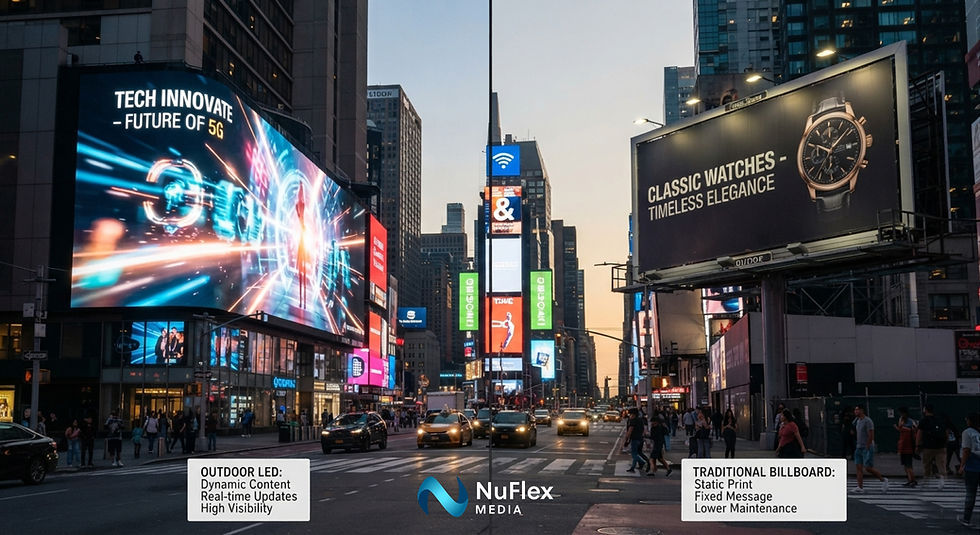
For most of the last century, "out-of-home advertising" meant one thing: a static billboard, printed once, up for weeks or months, and essentially unmeasurable beyond traffic counts. Outdoor LED displays change nearly every part of that equation, and it's worth being specific about how.
Flexibility is the biggest structural difference
A traditional billboard is fixed the moment it's printed. Changing the message means a physical reprint and a crew to install it — a process that can take days and cost real money each time. An outdoor LED display can update in seconds from a cloud-based content system, which means a single screen can run a morning promotion, an afternoon message, and an evening brand spot without anyone touching the hardware. For businesses that run seasonal offers, time-sensitive promotions, or multiple campaigns, that flexibility alone often justifies the switch.
On measurability
Static billboards have always relied on estimated traffic counts to justify their price. Digital out-of-home, by contrast, increasingly comes with real measurement tools — impressions tied to device or footfall data, and in some markets, brand-lift and store-visit attribution studies. Whether or not a business uses that level of measurement, the option exists in a way it never has for print.
What consumers actually do after seeing digital out-of-home
Recent industry research on digital out-of-home advertising found that a strong majority of consumers report taking some kind of action after seeing a DOOH ad — searching for the brand, visiting a store, or making a purchase. That's a meaningfully different outcome than the brand-awareness-only reputation static billboards have carried for decades.
Cost: where LED actually competes
Outdoor LED hardware costs more upfront than a printed billboard face. But billboards carry recurring costs too — printing, installation labor, and lost display time during changeovers — that add up over a multi-year period. An outdoor LED display, properly weatherproofed and maintained, is built for continuous operation across many years with no reprinting costs at all. The comparison isn't "cheap vs. expensive" so much as "recurring cost vs. upfront investment."
What "properly built" actually means outdoors
Not every outdoor-rated display is engineered the same way. A display that will genuinely last outdoors needs an IP-rated weatherproof housing, brightness high enough to stay legible in direct sunlight, and thermal management to prevent performance loss during summer heat. Skipping any of these to hit a lower price point is one of the most common ways outdoor LED projects go wrong.
Getting the comparison right for your business
The right answer depends on your location, how often your message needs to change, and how long you plan to occupy the space. For a business with a stable, long-running brand message and a very tight budget, a well-placed static sign can still make sense. For nearly everyone else — especially retail, hospitality, and businesses running regular promotions — outdoor LED delivers more flexibility and, over the display's lifespan, often a stronger return.
NuFlex Media designs and installs outdoor LED displays built for real-world conditions, not showroom lighting. Talk to our team about what a properly engineered outdoor display would look like for your location.

Comments